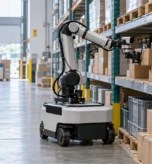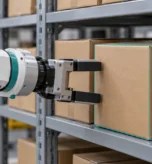

A robotics training dataset records what a robot sees and does as it carries out a task. For a warehouse picking robot, that means capturing how it locates a package and lifts it clear without disturbing the boxes around it.
An open shelf gives the robot’s two-finger gripper room to approach the package. When the same box is wedged between two others, the camera may still see the box even though it can’t see where the gripper needs to make contact. That difference should guide your data collection plan, because another recording of an easy pick tells the robot little about how to approach the wedged box.
In this article, we explain how to plan collection around the decisions your robot will face on the job and test how it handles them. Before you decide how to record a pick, define what the robot needs to do when the shelf is crowded and what counts as success.
What Must a Physical AI System Prove Before Deployment?
Every market the warehouse robot enters asks a version of the same five questions, each demanding a different kind of evidence. The first two concern the machine itself. The other three concern the data it learned from and who is responsible once it is in service.
1) Safety Around People
A picking robot shares aisles with people who cross its path or restock the shelf it is working on. Sooner or later, someone will leave a pallet where the robot expects an open floor. The manufacturer needs test results showing that the robot slows or stops safely in each of those moments.
In the EU, the Machinery Regulation (EU) 2023/1230 applies from 20 January 2027 and requires manufacturers to identify hazards and reduce risk before sale. For industrial robots, the main reference points are the 2025 editions of ISO 10218. Part 1 covers the robot’s design and Part 2 covers its integration into an application.
Because the picker moves through shared floor space, the manufacturer must determine which standards fit its design and intended use before testing against them. Those tests become harder to design once a learned model, rather than fixed code, decides how the robot reacts to a person in its path.
2) Control of Learned Behaviour
Suppose the warehouse robot uses a learned model to detect workers and steer around them. That model now performs a safety function, so the manufacturer must test how it behaves when conditions shift. The tests should include a worker who steps out from behind a shelving unit, partly hidden and moving quickly.
Under the Machinery Regulation, that design choice changes who signs off on the robot. Machine-learning safety components that keep learning in service count as high-risk, so a notified body has to assess them. Baker McKenzie’s analysis sets out how these categories differ from the old Machinery Directive.
A model that stops learning after training may fall outside this category, so teams should settle the question with a notified body early. How that model behaves also depends heavily on what it saw during training, which brings the two warehouses back into focus.
3) Training Data Fit for the Job
Footage from two warehouses captures two sets of shelving and two lighting setups, along with the habits of two workforces. The manufacturer needs to check whether that footage matches the products and layouts at customer sites. Workers there may also move differently from the ones on camera.
Machinery now sits outside the AI Act’s direct high-risk regime. Even so, the requirements moving into machinery law draw on the Act’s high-risk rules. Article 10 is the benchmark, requiring data that is relevant and sufficiently representative of the system’s intended purpose.
In the US, the voluntary NIST AI Risk Management Framework helps teams identify data-quality risks. It also helps them check whether the system performs reliably where it will run. Checking representativeness means closely reviewing the footage itself, which often captures more than the task being demonstrated.
4) Lawful Handling of Personal Data
A worker wearing a head-mounted camera to record a picking task also records their surroundings. Colleagues walk past the camera, and conversations carry onto the audio track. A customer order may even be readable on a nearby screen.
Where the footage identifies people, the GDPR and UK GDPR require a lawful basis for using it. People recorded must also be told how their footage will be used, and retention must be limited to what the training purpose requires.
In the US, the rules depend partly on the state where recording happens. California requires everyone in a confidential conversation to consent before recording. Audio captured on a picking shift there needs a stricter consent process than footage from a one-party consent state.
Consent and retention govern the people captured in the footage, while liability governs the people the finished robot works beside.
5) Liability When the Robot Fails
If the warehouse robot injures a worker because of a design or software defect, the manufacturer faces a product-liability claim. Responsibility can extend to others in the supply chain, such as an integrator that modifies the robot for a customer site.
The EU Product Liability Directive (EU) 2024/2853 brings software, including AI systems, into the EU’s strict liability regime. An injured person must prove the defect and the damage it caused, but not fault. The rules cover products placed on the market or put into service from 9 December 2026, the deadline for Member States to transpose the directive.
In the US, product liability varies by state. Test results, design records and incident logs help establish what went wrong after an injury, although keeping them does not shield a manufacturer from liability. The five questions hold in every market, though each market enforces them through different instruments.
How Do the Rules Differ Across the EU, UK and US?
The EU is folding its AI obligations for machinery into machinery law itself. Great Britain is aligning with that approach through its own legislation. The US relies instead on consensus standards and buyer requirements, with product-liability law applying after an incident.
The EU: The Most Prescriptive Rulebook
The Machinery Regulation applies from 20 January 2027 and replaces the Machinery Directive 2006/42/EC. In July 2026, the EU adopted the Digital Omnibus on AI (Regulation (EU) 2026/1744). It moved machinery out of the AI Act’s direct high-risk regime and into sector-specific rules.
Under the omnibus, the Commission must set out the relevant AI requirements in the Machinery Regulation through delegated acts. Those acts are due to apply by 2 August 2028. ERTICO’s summary of the omnibus notes that, until machinery-specific standards arrive, meeting AI Act standards gives a presumption of conformity.
For the warehouse robot, the machinery rules take effect in January while the AI rules it will eventually meet are still being drafted. Great Britain has chosen to follow this approach and is legislating on its own timetable.
The UK: Following the EU on Machinery, Tailored for Great Britain
The UK has already legislated for the change. The Supply of Machinery (Safety) (Amendment etc.) and the EU Machinery Regulation (Enforcement etc. in Northern Ireland) Regulations 2026 come into force on 20 January 2027, matching the EU date. They make the EU regulation enforceable in Northern Ireland and allow manufacturers to use either CE or UKCA marking in Great Britain.
The government has also committed to updating the Supply of Machinery (Safety) Regulations 2008 in Great Britain, according to its response to the machinery call for evidence. The update will add measures similar to the EU regulation, adapted for UK conformity assessment. Gowling WLG expects manufacturers of high-risk machinery to face a restructured conformity assessment approach once that legislation arrives.
Until then, a manufacturer selling the warehouse robot in Great Britain should follow the GB conformity and documentation rules in force at the time. It should also check the final legislation before placing units on the market. The US has no equivalent machinery regulation, which shifts much of the weight onto standards and the people buying the robot.
The US: Standards, Buyers and Courts
No single federal law governs AI in robots. OSHA confirms it has no standards written specifically for robotics. Its general rules on machine guarding and hazardous-energy control still apply to robot operations.
Industry fills that space with consensus standards such as ANSI/A3 R15.06-2025, which adopts the 2025 editions of ISO 10218 for industrial robot safety. For a mobile picker, the ANSI/A3 R15.08 series is more relevant. Its parts cover the mobile robot, its integration into a site and, since 2026, its day-to-day use.
Although these standards are not OSHA regulations, buyers use them as a baseline. Before signing a purchase order, a warehouse operator may ask to see how the robot handles blocked aisles and workers crossing its path.
If the robot later injures a worker, investigators and courts will examine its safety systems and test records to see whether its design or operation contributed. Across all three markets, the harder part is producing the evidence behind each answer.
What Challenges Make Physical AI Compliance Hard?
Knowing which rules apply is the easier half. Five problems tend to surface when a team tries to show that the warehouse robot behaves safely outside the two sites it learned from.
1) Training Data That Does Not Match the Deployment Site

The two source warehouses may have bright, even lighting and matte packaging. A customer site may have dim mezzanine levels, reflective shrink-wrap and racking the robot has never seen.
The manufacturer has to find those gaps in the footage and test the robot against them directly. Where the footage shows little lighting variation, tests should confirm that the robot still recognises and picks products safely in dim or uneven light.
When annotators log the conditions each clip covers, those gaps show up in the dataset record instead of on a customer floor. Those checks describe the robot at the moment of sale, which matters less if the robot keeps learning once it is installed.
2) Robots That Keep Learning After Sale
Some robots keep learning after they start working in a warehouse. If that learning changes how the robot responds to workers or obstacles, the version that passed testing is no longer the version on the floor.
Under the Product Liability Directive, an update or continuous learning can amount to a substantial modification. When it does, the modified product is treated as newly placed on the market.
Baker McKenzie notes that the directive’s longstop liability period restarts from that point. A manufacturer can be held liable when a change under its control makes the robot defective and causes damage.
Teams can keep that behaviour traceable by tracking which model version each robot runs and re-testing safety functions whenever learning changes them. The footage used to train it raises separate questions about the people it captured.
3) Faces and Voices Inside Egocentric Video
Egocentric video, filmed from the worker’s point of view, is valuable because it shows the task as a person performs it. It also captures co-workers who walk into the shot, along with whatever they say while the camera is running.
Teams should settle the lawful basis and retention period before recording begins, since both are hard to fix once the footage exists. Blurring faces reduces the privacy risk, although voices and on-screen text can still identify people and need their own treatment during annotation.
Some teams supplement real footage with simulation, which removes privacy concerns but introduces documentation issues.
4) Simulation Data With No Paper Trail
A robot may train partly in a virtual warehouse that differs from the sites where it will work. If the simulation omits obstacles or renders lighting unrealistically, the robot learns from conditions it will never encounter.
Regulators and buyers will want to know how the simulated scenes were built and which dataset version trained and tested the robot. Recording those details while the data is generated is far easier than reconstructing them after a buyer or notified body asks. That documentation matters even more because the rules it must satisfy are still changing.
5) Rules and Standards That Are Still Moving
The EU’s AI requirements for machinery will arrive through delegated acts that have not yet been adopted. Great Britain’s broader update to its 2008 machinery regulations is also still to come.
Robotics teams can only test against the requirements already in force. When risk assessments and design decisions sit alongside those test records, a team can see what extra evidence each new rule demands. The next two years already have fixed dates to plan against.
How Should Robotics Teams Prepare Now?

Three dates set the pace. National law on the Product Liability Directive is due by 9 December 2026. The Machinery Regulation follows on 20 January 2027, with the AI requirements for machinery due by 2 August 2028.
Data records come first, because they are the hardest to recreate later. For every dataset, the team should record the footage source and how it was labelled. It should also note which version went into each training run.
Gap testing follows from those records. Once the team knows which conditions the footage covers, it can compare them with each customer site. It can then test the robot in the situations the data misses.
Test records then tie the work together. Storing results with risk assessments, simulation records, and software versions shows which robot version passed which test. An investigator or notified body will need to see exactly that.
Build the Evidence While the Data Is Still Fresh
Each of these requirements eventually traces back to the data the robot learned from. Teams that keep data records, quality checks and test results together from the first collection run spend far less effort when an auditor asks for evidence. They also reduce the risk of failures once the robot ships and starts working in real-world conditions.
Aya Data helps robotics teams source, annotate and quality-assure specialist training data, including egocentric demonstration video. It also supports them as they build and deploy the solutions that data trains. Scope a pilot to work out the evidence your next dataset needs to carry.
Frequently Asked Questions
Does the EU AI Act apply to robots?
It depends on the robot and how it is regulated. Under the Digital Omnibus on AI, machinery will meet its AI requirements through the EU Machinery Regulation instead of the AI Act’s high-risk rules. Those requirements are due to apply by 2 August 2028.
When does the EU Machinery Regulation apply?
The EU Machinery Regulation (EU) 2023/1230 applies from 20 January 2027, replacing the Machinery Directive 2006/42/EC.
Can CE-marked machinery still be sold in Great Britain?
Yes. UK regulations in force from 20 January 2027 continue to recognise CE-marked machinery that meets the EU Machinery Regulation. Manufacturers can use either CE or UKCA marking in the GB market.
Is there a US federal law for AI in robots?
No single federal law regulates AI in robots, and OSHA has no robotics-specific standards. General workplace safety rules still apply to robot operations. ANSI/A3 R15.06-2025 and the R15.08 series add voluntary safety requirements for industrial and mobile robots.
What is ISO 10218?
ISO 10218 is a two-part international safety standard for industrial robots. The 2025 editions cover robot design and the safe integration of robots into applications, including collaborative applications. They also include cybersecurity requirements where these affect robot safety.
Does GDPR apply to egocentric videos used to train robots?
Yes, if the footage can identify workers or anyone else. Before collecting video, teams should check whether faces, voices or on-screen text could identify people. They then need a lawful basis and a retention period.
Does the EU Product Liability Directive cover AI software?
Yes. Directive (EU) 2024/2853 treats software, including AI systems, as a product, so its manufacturer can be held liable for damage. EU Member States must transpose it by 9 December 2026.